
Pearland Property Taxes & MUDs: Buyer Essentials
Pearland Real Estate, Property Taxes, MUDs, Home Buying Tips
Pearland Property Taxes & MUDs: What Buyers Should Know
When you're buying a home in Pearland, the sales price is only one part of the financial picture. This guide walks you through how property taxes, MUDs, HOAs, insurance, and other local factors can change your true monthly cost of owning a Pearland home.
Looking Beyond the Sales Price in Pearland
When you're buying a home in Pearland, the sales price is only one part of the financial picture.
Two homes with similar asking prices can have different monthly ownership costs because of property taxes, Municipal Utility Districts (MUDs), HOA dues, homeowners insurance, and other property-specific expenses. That's why buyers should look beyond the mortgage principal and interest before deciding what they can comfortably afford. Understanding the tax structure attached to a particular Pearland home can help you compare properties more accurately and avoid surprises after closing.
How Do Property Taxes Work in Pearland?
Property taxes in Texas are generally collected by several taxing authorities rather than one single entity. Depending on the property's exact location, those taxing authorities may include:
City
County
School district
Municipal Utility District
Emergency services district
Other special-purpose districts
The combination can vary from one property to another. This means there isn't one property tax rate that should automatically be applied to every home with a Pearland address. For example, the City of Pearland’s proposed FY 2026–27 rate is $0.627892 per $100 of assessed value, slightly below the prior year’s $0.630000 rate, but that city rate is only one piece of a Pearland homeowner’s total tax bill (abc13.com; pearlandtx.civicweb.net). When you're considering a particular home, research the taxing entities associated with that exact address rather than relying on a citywide “average.”
Why Can Two Pearland Homes Have Different Property Taxes?
A Pearland mailing address doesn't necessarily tell you everything about the home's tax structure. Properties that appear close together may fall within different taxing jurisdictions or special districts. For example, one home might be located within a Municipal Utility District while another may have a different combination of taxing entities. Even when two homes have comparable values, their annual tax obligations can differ.
For buyers comparing properties, the more useful question is not simply:
“What are property taxes in Pearland?”
Instead, ask:
“What are the taxes associated with this specific Pearland property?”
That distinction can give you a much more realistic picture of ownership costs.
What Is a MUD?
MUD stands for Municipal Utility District. A MUD is a governmental district that may help provide infrastructure and services to properties within its boundaries. Depending on the district, those services can include:
Water
Wastewater
Drainage
Infrastructure
Other authorized community services
MUDs are common throughout many suburban and developing areas of Greater Houston. In and around Pearland, active districts include Brazoria County MUDs 17, 18, 19, 23, 26, 28, 34, 35 and Harris County MUD 509, along with others in the city’s extraterritorial jurisdiction (pearlandtx.gov). For buyers, the important point is that a property located inside a MUD may have additional taxes or charges associated with the district.
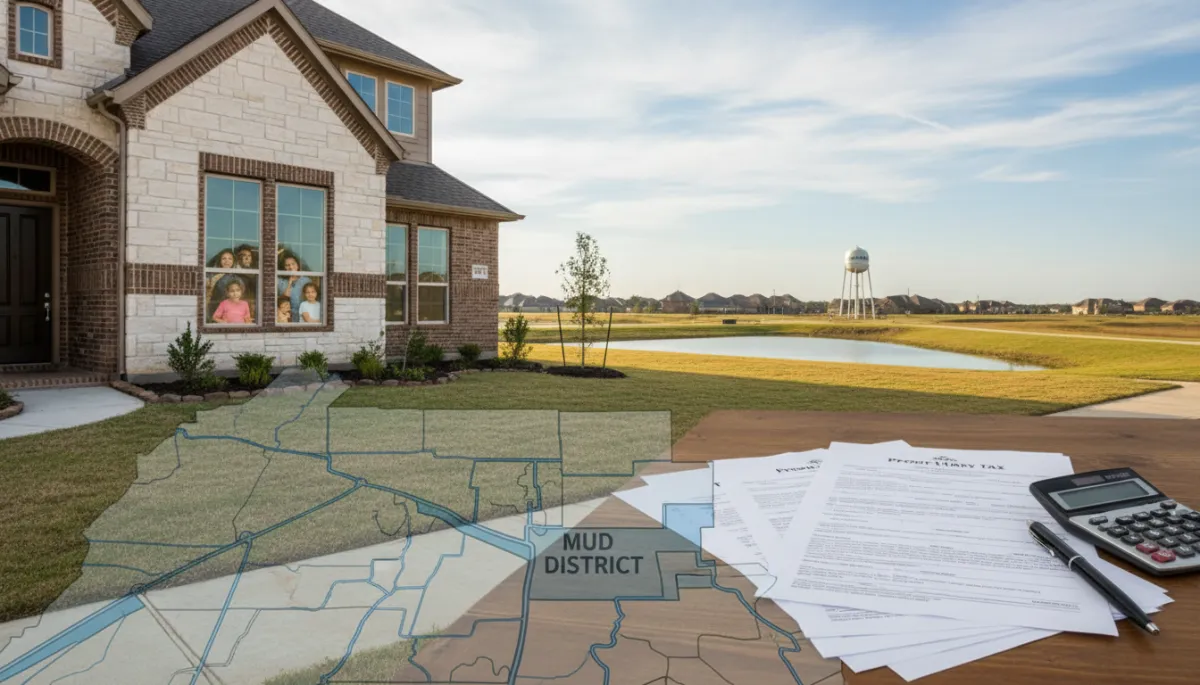
Similar-looking Pearland neighborhoods can sit in very different MUD and tax districts.
Why Are MUDs Common in the Houston Area?
As new communities develop, they often require substantial infrastructure before homes can be built and occupied. Water systems, wastewater facilities, drainage improvements, and other infrastructure require funding. Municipal Utility Districts are one way those services can be financed and operated. MUDs aren't unique to Pearland, but they are something Greater Houston buyers should understand when comparing suburban properties.
Does Every Pearland Home Have a MUD?
No. Not every Pearland property is located within a Municipal Utility District. This is one reason property-specific research matters. Don't assume that a home has—or doesn't have—a MUD simply because of its neighborhood name, ZIP code, or marketing description. Verify the information for the particular property using MUD maps, tax records, or by asking your real estate professional to help you confirm the district status.
Is a MUD the Same as an HOA?
No. A Municipal Utility District and a homeowners association perform different functions. A MUD is a governmental district that may provide infrastructure and utility-related services. An HOA generally manages community rules, common areas, amenities, and other responsibilities outlined in the association's governing documents.
A Pearland home could potentially have:
A MUD
An HOA
Both
Neither
When estimating ownership costs, buyers should identify each separately.
How Can MUD Taxes Affect Your Monthly Mortgage Payment?
Many buyers have property taxes collected through an escrow account as part of their monthly mortgage payment. If a property has higher overall taxes because of applicable taxing entities, the amount collected through escrow may also be higher.
Imagine two homes listed for the same price. The mortgage principal and interest may be similar, but one home could have higher taxes. That means the estimated total monthly housing payment could be different. This is why buyers should request a property-specific payment estimate rather than assuming homes with similar prices will cost the same each month.
Should You Rely on the Seller's Current Tax Bill?
The seller's tax information can be useful, but it may not perfectly predict what you will pay. The current owner may have exemptions that apply to their individual circumstances. The property's assessed value may also change. Tax rates can change over time as well. Use available records as an important part of your research, but don't treat a seller's current tax bill as a guaranteed future amount. Your lender, real estate professional, and applicable tax authorities can help you research current information.
What About Homestead Exemptions?
Eligible homeowners in Texas may qualify for certain exemptions that can reduce the taxable value used by specific taxing authorities. However, exemptions are based on eligibility and circumstances. A buyer should not automatically assume they will receive the exact same exemptions as the current owner. If you're planning your future housing costs, research your potential eligibility separately with the county appraisal district or a trusted professional.
What About HOA Fees in Pearland?
Many Pearland neighborhoods have homeowners associations. HOA dues may help maintain various community features, which could include:
Common landscaping
Neighborhood entrances
Community pools
Recreation facilities
Trails
Common areas
Community management
Exactly what the HOA maintains varies from community to community. Before buying, review the applicable association documents and understand:
Current dues
How often dues are paid
What the HOA maintains
Community restrictions
Available amenities
Any other applicable assessments or obligations
The existence of an HOA isn't automatically good or bad. What matters is understanding the financial obligation and what comes with it. In Pearland, master-planned communities commonly range from about $75 to $175 per month in HOA dues, with some amenity-rich or gated neighborhoods running higher (movemetotx.com).
Why Insurance Should Be Part of Your Pearland Home Budget
Taxes aren't the only property-specific expense that can affect your monthly payment. Homeowners insurance premiums can vary depending on the property. Factors that insurers may consider can include:
Home age
Roof condition
Construction
Coverage amount
Deductible
Previous claims
Location
Replacement cost
Other underwriting factors
This means an insurance premium from another house—even in the same community—may not accurately predict what you'll pay. Getting a property-specific insurance estimate early in the buying process can help you develop a better budget.
What Should Pearland Buyers Know About Flood Research?
Flood risk should also be investigated by individual property. Don't rely on a general statement about Pearland or a particular neighborhood. Buyers may want to review:
Current flood mapping
Seller disclosures
Available property history
Drainage information
Insurance requirements
Flood insurance options
Elevation information where relevant
A home's flood-zone designation is useful information, but it isn't necessarily the only factor worth researching. Local drainage patterns, past events, and upcoming improvements can all be part of a thorough review.
How Should You Compare Two Pearland Homes?
When comparing properties, create a more complete ownership estimate. Instead of comparing only this:
Home A: $425,000
Home B: $425,000
Compare this:
Home A
Purchase price
Estimated mortgage
Property taxes
MUD taxes, if applicable
HOA dues
Homeowners insurance
Flood insurance, if applicable
Utilities
Estimated maintenance
Home B
Purchase price
Estimated mortgage
Property taxes
MUD taxes, if applicable
HOA dues
Homeowners insurance
Flood insurance, if applicable
Utilities
Estimated maintenance
This gives you a much better picture of how the properties fit your monthly budget.
What Else Should Buyers Consider When Moving to Pearland?
Commute Routes
Look at the roads and routes you'll actually use. A location that appears close on a map may feel very different during weekday traffic. If you'll regularly commute toward Downtown Houston, the Texas Medical Center, Hobby Airport, or another employment center, test your likely routes when possible.
Property Condition
Homes of the same age can have very different maintenance histories. A professional inspection can help you understand the current condition of major systems and components.
Neighborhood Amenities
Compare community amenities objectively. Look at features such as:
Parks
Trails
Recreation centers
Pools
Shopping access
Restaurants
Major roads
Community facilities
School Zoning
Never assume every property in Pearland is zoned to the same school district or campuses. School assignment should be verified directly for the specific property.
Questions to Ask Before Making an Offer on a Pearland Home
Before making an offer, consider asking:
What taxing jurisdictions apply to this address?
Is the property located within a MUD?
What are the current HOA dues?
Are there additional assessments?
What does the HOA maintain?
What does the seller disclose about flooding?
What does an insurer estimate for coverage?
What is the estimated total monthly payment?
What school district and campuses currently serve the property?
What major maintenance expenses may be approaching?
These questions can help you evaluate the property rather than relying solely on its asking price.
Frequently Asked Questions About Pearland Property Taxes and MUDs
What does MUD mean in Pearland?
MUD stands for Municipal Utility District. These governmental districts can help provide infrastructure and services such as water, wastewater, and drainage.
Does every Pearland home have MUD taxes?
No. MUD status depends on the specific property and should be verified before purchasing.
Are MUD taxes the same as HOA dues?
No. MUDs and homeowners associations are separate organizations with different responsibilities.
Why can two Pearland homes have different tax rates?
Properties may fall under different combinations of city, county, school district, MUD, and other taxing authorities.
Can property taxes affect my mortgage payment?
Yes. When property taxes are collected through escrow, the estimated tax obligation contributes to the total monthly payment.
Is the seller's current tax bill what I will pay?
Not necessarily. Exemptions, assessed values, tax rates, and ownership circumstances can change.
Should I check insurance costs before making an offer?
Getting an insurance estimate early can help you better understand the potential total monthly cost of owning the home.
What should I compare besides the sales price?
Compare taxes, MUD obligations, HOA dues, insurance, property condition, maintenance, flood considerations, commute routes, and other ongoing expenses.
Thinking About Buying a Home in Pearland?
A home's asking price is important, but it doesn't tell the whole story. Property taxes, MUDs, homeowners association expenses, insurance, property condition, and location can all affect the real cost of ownership.
Jen Tran, REALTOR® and Broker Associate with Keller Williams Memorial, can help you compare Pearland properties beyond the list price and understand the property-specific details worth researching before you make an offer.
